One command turns a markdown brief into gerbers, firmware and docs. A walk through the eight stages and what each one has to prove before the next starts.
Eight stages, eight commits, one command.
You point copperhead at a markdown file and it hands back a design package. That is a large claim for one command, and the schematic capture is the smallest part of it. What carries it is the bookkeeping: what each stage has to prove before the next one is allowed to start and what happens to the work when it cannot prove it.
The run’s entire input prompt:
# USB-C 5V power breakout

A pass-through: USB-C in, protected 5V out. No regulation, no MCU.

- 5V from VBUS, rated 3A continuous. No PD negotiation.
- Out: 2-pin 3.5mm screw terminal and a 2x2 0.1" header.
- Power-good LED, under 1mA. Short-circuit protection.
- 30 x 20mm, two M3 holes, hand-solderable (0603 minimum).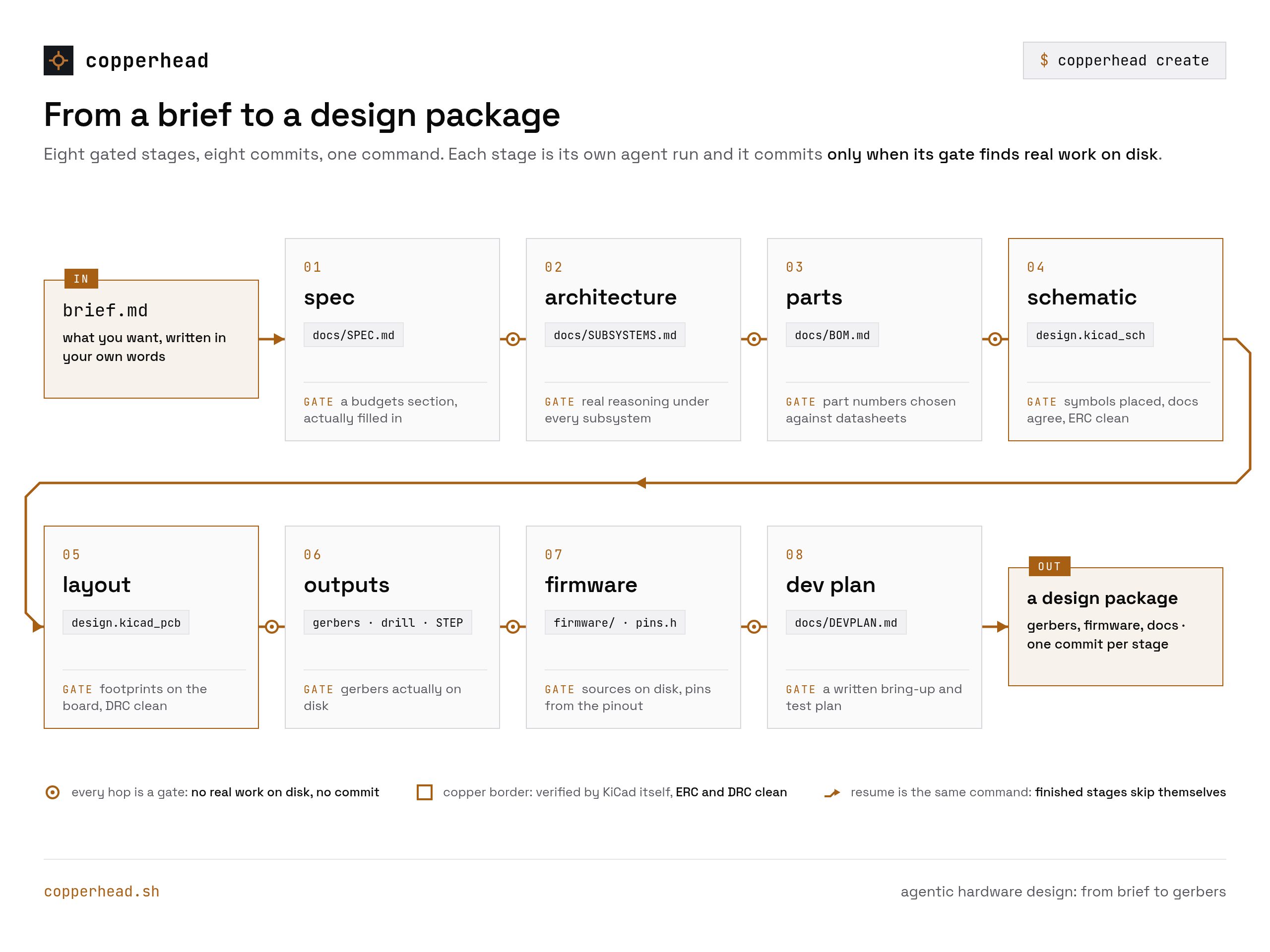
The shape of the run: one file in, eight gates, a design package out
One file goes in
mkdir usb-c-breakout && cd usb-c-breakout

# a sentence: copperhead writes it to brief.md for you
copperhead create "a USB-C 5V power breakout, 3A, screw terminal and header, power LED"

# or write brief.md yourself, in as much detail as you like, and point at it
copperhead create --brief brief.md
Either way you end up with one real file on disk. The sentence form just writes
brief.md for you before anything else happens. Two later things depend on that file
being real. The resume command has to point at a path, and every stage stamps a
sha256 of the brief into its run metadata, so a brief edited halfway through the
pipeline shows up as a changed hash instead of quietly moving the target.
Then git gets set up. create initializes a repository, sets a repo-local identity,
writes the baseline .gitignore, makes the first commit and commits the brief on
top. That is not a convenience. Every stage snapshots HEAD before it starts, and a
failed run restores that snapshot with a hard reset and a clean, sparing only the
run’s own audit trail. Committing the brief up front is what guarantees the file the
resume command points at is still there afterwards.
The other two entry points, do and sync, keep the strict refusal on a dirty
tree. Those run against a repository you already own, where an implicit initial
commit would be a surprise rather than a courtesy.
Eight stages
Every markdown file in the table below lives under docs/.
| Stage | Asked for | Gate |
|---|---|---|
| Spec | SPEC.md, budgets as constraints |
Budgets filled in |
| Architecture | SUBSYSTEMS.md, reasoning per subsystem |
Real prose under a heading |
| Parts | BOM.md, verifiable part numbers |
A part chosen, not placeholder |
| Schematic | the .kicad_sch, subsystem by subsystem |
Symbols, agreement, ERC clean |
| Layout | placement, routing, a draft quality note | Footprints, draft note written |
| Outputs | gerbers, drill, STEP, renders, order BOM | Gerbers actually on disk |
| Firmware | firmware/ with generated pins.h |
Source files on disk |
| Dev plan | bring-up order, test points, risks | A written plan, not empty |
Each stage is a complete agent run with its own prompt, its own turn budget and its own commit. It is not one long conversation with eight topics in it. A stage that cannot pass its gate stops the pipeline and prints the exact command to pick up from there.
The gate is never “the file exists”
This is the part worth reading.
copperhead init scaffolds most of those markdown files before an agent writes a
word. SPEC.md ships with a budgets heading and two HTML comments under it.
SUBSYSTEMS.md gets auto-generated per-sheet headings full of - R1: 10k bullets
pulled straight off the schematic. BOM.md arrives pre-filled with rows whose part
number column reads UNVERIFIED. LAYOUT.md arrives with the literal
## Draft quality heading that stage 5 is supposed to write.
So in a repository that has been through init, and that is how copperhead gets
pointed at an existing board, a gate that only asks whether the file exists marks
stages complete that have produced nothing. Every gate looks for evidence instead:
- Spec: the budgets heading, plus at least one line beneath it that is neither blank nor an HTML comment. A filled section, not an empty placeholder.
- Architecture: a section heading, plus a line of prose that is neither scaffold boilerplate nor one of the auto-generated refdes bullets.
- Parts: at least one BOM row whose part number column is not the
UNVERIFIEDplaceholder. Somebody chose something. - Schematic: symbols exist, the BOM and pinout tables agree with them and ERC passes.
The schematic gate is three conditions because each one was learned separately. Symbols alone lets an empty capture through. Symbols plus agreement still passes on a schematic with unconnected pins, which is exactly what a run killed mid-capture leaves behind. Treating that as done means layout and outputs both run against a board that is not there.
The same check runs again after a stage reports success. An agent can call finish
with every gate green having only planned the work: one edit to a file header, then
ERC on an empty sheet, which is of course clean. So the run ending well and the
stage being done are two separate questions, and only the second one advances the
pipeline.
The gates do share one blind spot. Every text and exit-code check in the pipeline can be satisfied by a design that is visibly wrong, and nothing else in the run ever looks at the board. So every stage that touches the KiCad files renders the schematic and the board to SVG into its own run directory. A render costs nothing and closes that gap.
Resuming is free
Completion is read entirely off the repository, so there is no pipeline state file,
no checkpoint, no --resume-from. Resuming is running the same command again.
Finished stages announce themselves and get skipped.
One subtlety sits underneath that. If a resumed stage’s work is sitting uncommitted, which is what a run stopped on a provider usage limit leaves behind, it gets committed before the pipeline moves on, so a later stage’s rollback cannot wipe it. That commit only happens when every dirty path in the tree belongs to copperhead. If your own uncommitted work is sitting next to it, the pipeline says so and leaves the whole thing alone. Sweeping an engineer’s work in progress into an agent’s commit is worse than the problem it would be solving.
Inside a single stage
Each stage runs the same loop as any other copperhead run, and the two invariants of Spec-gated in, verification-gated out hold inside every one of them. Nothing starts without a validated change proposal, and nothing is done until the tools agree.
The first invariant is structural. The edit tools are not in the tool list the model is shown until a proposal has passed validation. Not discouraged in the prompt, absent from the catalog. An earlier version advertised them on every turn and enforced the lock at call time instead, which saved exactly one turn and traded a structural guarantee for it. That was the wrong trade and it was reverted.
The second shows up as a hook on every edit. Touch a .kicad_sch and the last ERC
result is discarded. Touch a .kicad_pcb and the last DRC result goes with it. When
the model then tries to end the run, it gets this back:
cannot finish yet:
- ERC has not passed since the last schematic edit (run run_erc)
- open sync obligations:
- [drift] check_drift must run clean after KiCad edits
That refusal arrives as an ordinary tool result, so the model reads it and goes back to work. It is not an error condition. It is the loop doing its job.
This is also where DRC gets enforced on the layout stage. The stage gate itself only asks whether footprints are on the board, because the board having been touched at all is what puts DRC in front of the run’s own exit. A layout stage cannot end successfully with DRC failing, so the gate does not need to ask twice.
The schematic stage carries extra scaffolding
An agent cannot create the KiCad files itself. write_file refuses KiCad files
outright, and edit_file needs an existing file to anchor into. So immediately
before stage 4, the pipeline drops an empty schematic, a blank board with a default
outline and a project file into place, and wires them into the config.
That scaffold is recreated before every attempt rather than once per stage. A failed attempt’s rollback deletes it, because at that point it is still untracked, and a retry against a missing schematic fails worse than the failure it was recovering from.
One more guard is specific to s-expression files. After every text edit to a schematic or a board, kicad-cli is asked whether the file still loads. If it does not, the edit is reverted with the parser’s complaint attached, because a corrupted file otherwise fails every later check with an opaque error and nobody can tell which edit did it. The exception is a file that was already unloadable before the edit. Reverting there would deadlock incremental repair, since every partial fix gets undone unless one lucky edit fixes the whole file at once. So that edit is kept and the probe output keeps the pressure on.
When a stage fails
There are two different failures here and they are handled differently.
A run can fail outright: a rate limit with no fallback, repair cycles running out, a
turn budget at zero. Then the loop rolls the tree back to the snapshot. It stashes
the touched work first, under a named stash entry you can restore with
git stash apply, so the rollback clears the working tree without destroying
anything.
The other failure is quieter. The run ends well but the gate says nothing usable came out of it. There is no rollback for that one. Whatever the attempt did stays in the tree and the next attempt builds on it.
Either way the model then gets asked, on a fresh turn with no tools available, whether another attempt is likely to help and what should be done differently. A retry runs the stage again with that guidance prepended to the prompt. An abort stops the pipeline for a human. Two retries by default, and the diagnosis call’s own token cost is folded into the stage’s total rather than hidden.
When the retries run out, the exact resume command gets printed, along with which stage it will pick up at.
What it costs
Every turn’s response is cached on disk against the repository. A retried stage replays what it already paid for instead of buying it twice, which is what turns “session limit reached” from a failure into a scheduled pause. Wait for the reset, run the same command, and the completed turns replay at roughly zero tokens.
At the end you get a per-stage cost table: wall clock, turns, output tokens, cache
hit rate, with the slowest and the most expensive stage called out. It is written to
.copperhead/runs/REPORT.md and to a JSON file next to it, so successive boards can
be compared rather than remembered.
What it does not prove
Worth being straight about. Stages 4 and 5 are verified against a real tool. ERC and
DRC either pass or they do not, and the pipeline cannot argue with the exit code.
The document stages check shape. A SPEC.md that is well formed and wrong passes
stage 1, and everything downstream inherits it faithfully.
That is exactly why anything the brief did not say gets flagged ASSUMED in the
spec, and why those flags are worth reading before the schematic stage rather than
after layout. Correcting an assumption at stage 1 costs a minute. Correcting it at
stage 6 costs the pipeline.
The full stage reference lives in the create workflow docs.