
We put an anycast edge in front of a single-region Azure app. TTFB fell sharply across Europe and Asia, but two South American probes became slower.
A probe in Delhi waited 775 milliseconds for the first byte from our app. Roughly 20 of those milliseconds looked like application work. The rest was the network path to our single Azure region in Virginia.
Moving the application closer was not practical, because authentication and tenancy depend on a database that lives in that region. So we tried a narrower change: put an anycast edge in front of the existing origin and leave the application alone.
It worked well in Europe and Asia. It also made two South American probes slower, and a handful of probes near the origin. This is what we measured, what broke during the rollout and which part of our explanation is still a hypothesis.
Two measurements, taken before anything moved
The first was ICMP round trip time to the origin’s address, three requests per location.
| Location | Avg | Std dev | Loss |
|---|---|---|---|
| New York | 7.10 ms | 0.49 ms | 0% |
| San Francisco | 68.18 ms | 0.29 ms | 0% |
| London | 77.78 ms | 0.41 ms | 0% |
| Amsterdam | 86.00 ms | 0.66 ms | 0% |
| Frankfurt | 90.93 ms | 0.02 ms | 0% |
| Sydney | 199.01 ms | 1.34 ms | 0% |
| Bangalore | 203.76 ms | 0.37 ms | 0% |
| Singapore | 221.84 ms | 0.23 ms | 0% |
Zero packet loss anywhere, standard deviation under 1.4 ms anywhere. These are healthy paths. They are just long.
The second was end to end time to first byte from a multi-region probe set, run on 16 August. It averaged 172 ms across America, 293 ms across Europe and 627 ms across Asia Pacific. Northern Virginia answered in 35 ms, London in 253 and Delhi in 775.
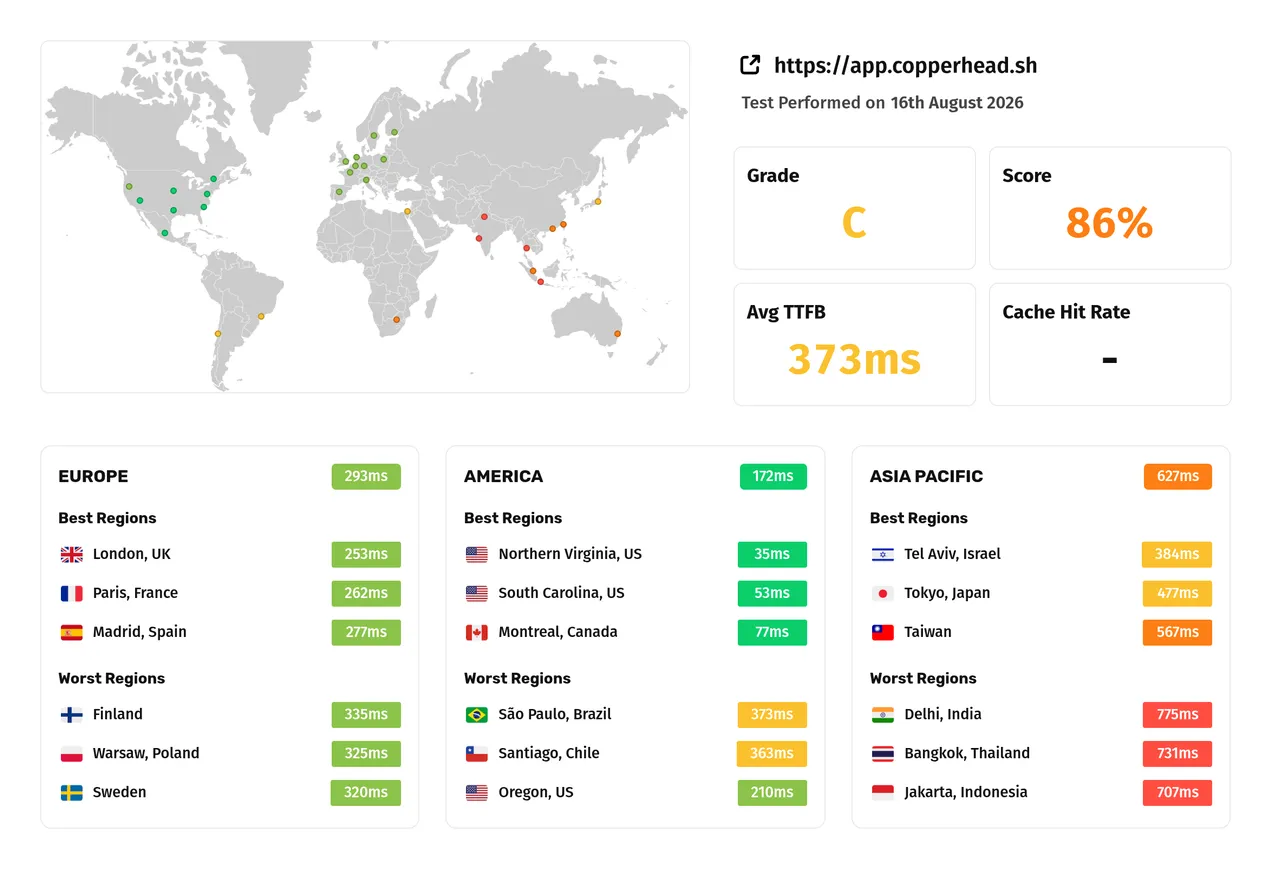
The baseline, 16 August. An average that mostly records how far each probe sat from Virginia.
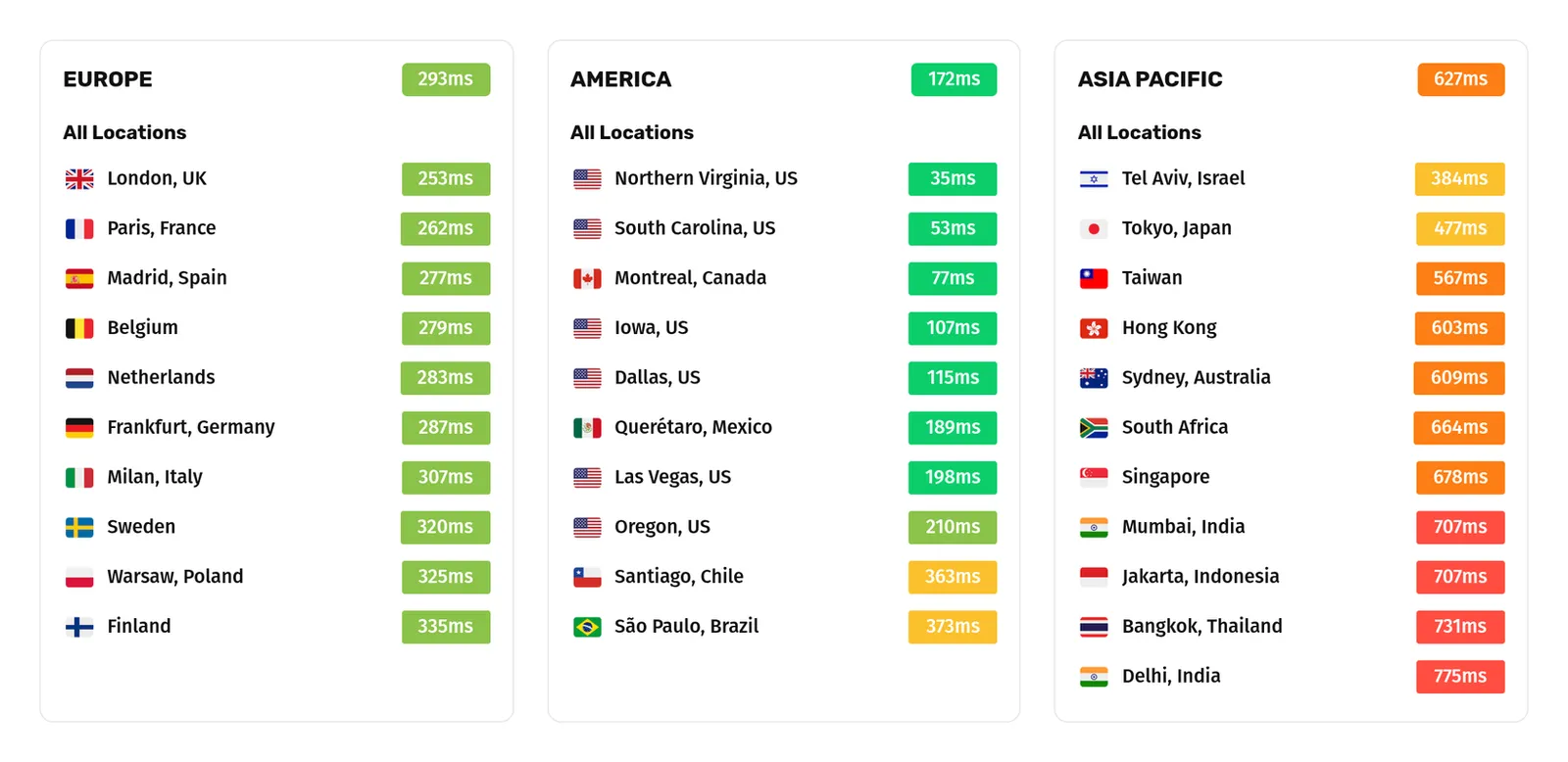
Asia Pacific is amber or red from end to end, and the application is identical for every row on the page.
A working model for where the time went
Both sets are consistent with a simple model: TTFB ≈ 3 × RTT + 20 ms. Three round
trips happen before a byte comes back, TCP handshake then TLS handshake then the
request itself, with the origin adding a roughly fixed cost on top.
We chose that model to fit these two sets, so the same sets cannot then confirm it. Four locations do appear in both under the same name, and those are the rows where each quantity was measured rather than inferred from the other.
| Location | Measured RTT | Model | Measured TTFB |
|---|---|---|---|
| London | 77.78 ms | 253 ms | 253 ms |
| Frankfurt | 90.93 ms | 293 ms | 287 ms |
| Sydney | 199.01 ms | 617 ms | 609 ms |
| Singapore | 221.84 ms | 686 ms | 678 ms |
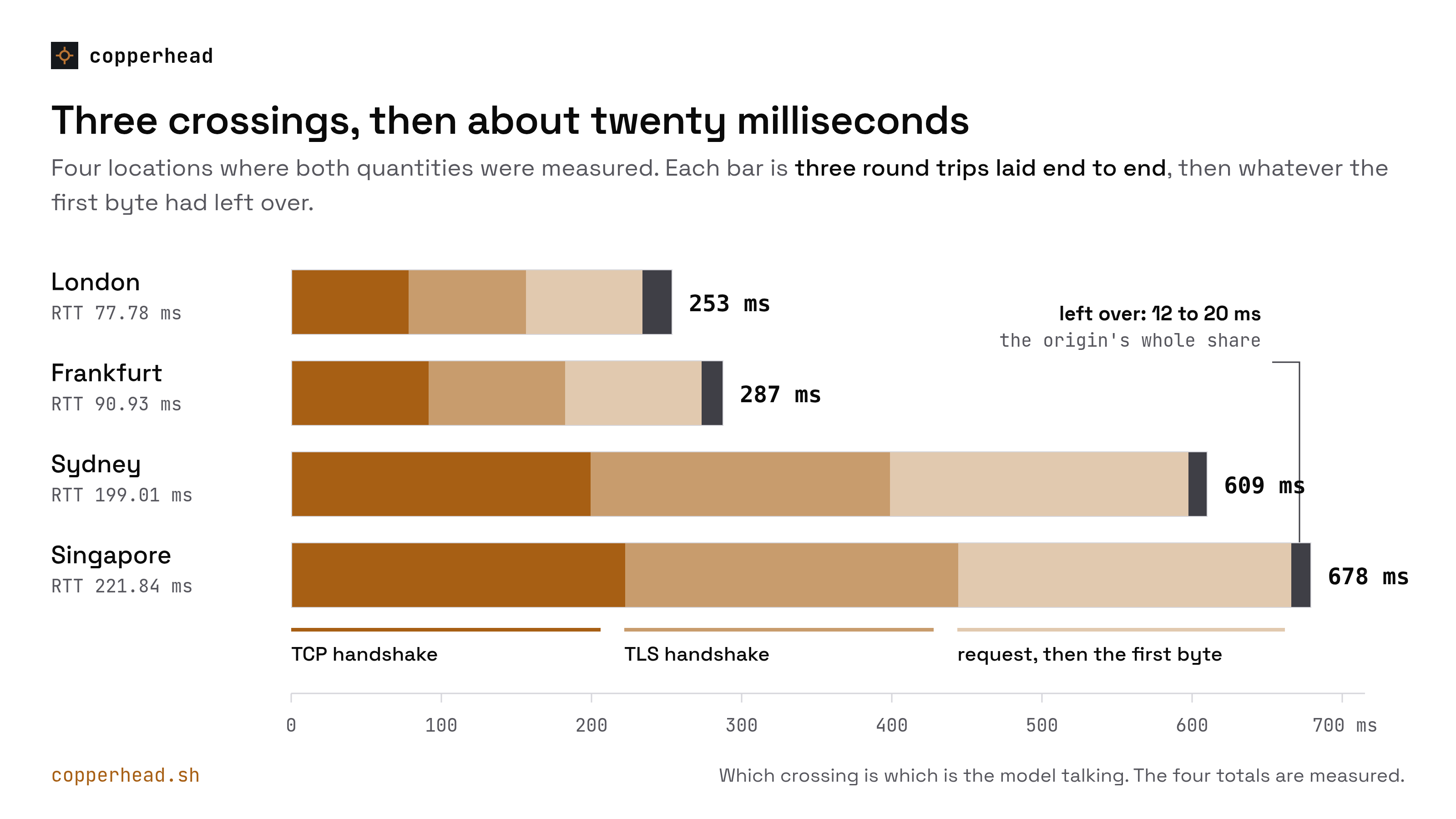
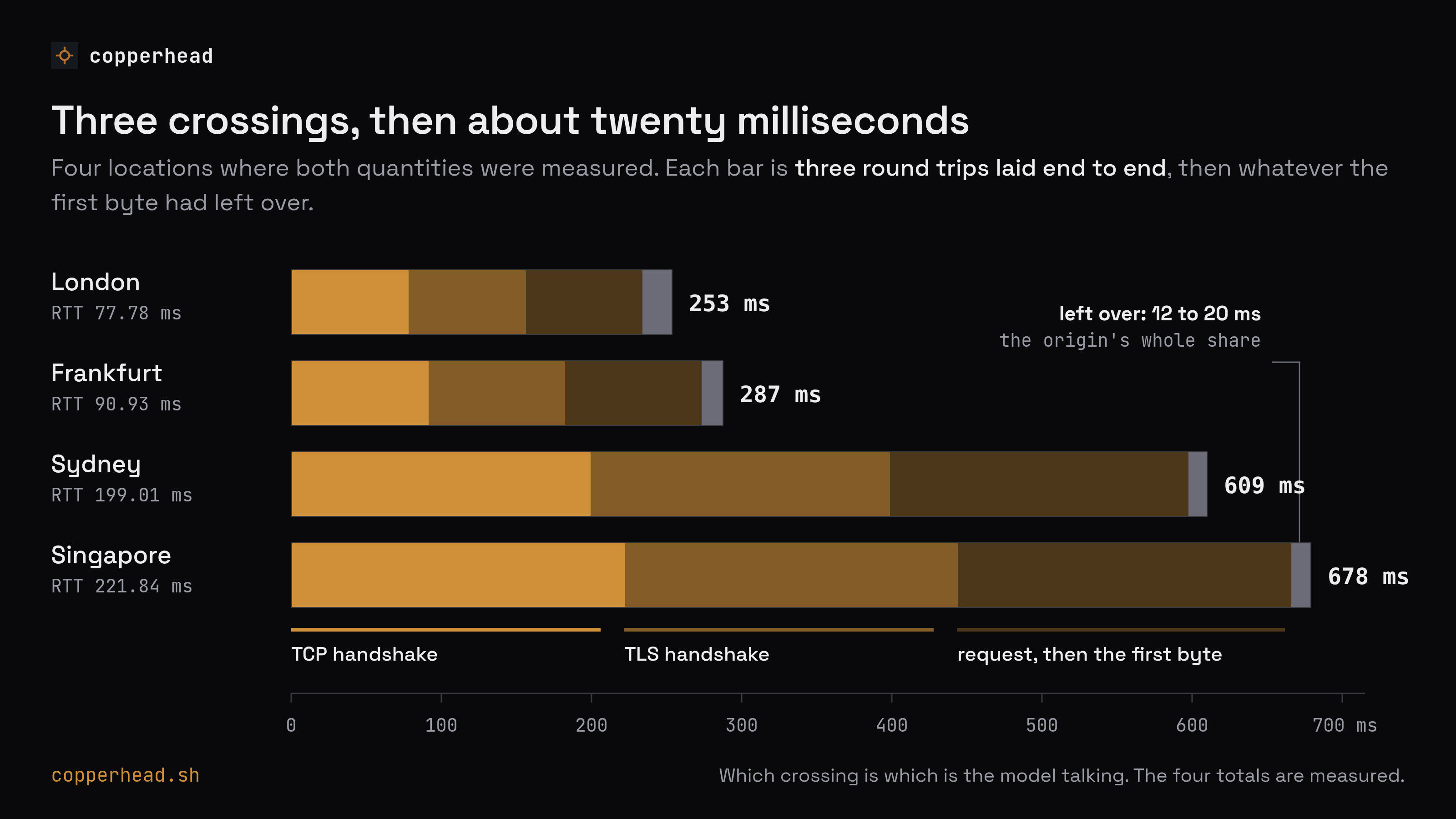
The same four rows, drawn to scale. Three round trips at the measured RTT account for everything except 12 to 20 ms, and that remainder is the whole of what the origin contributed.
London lands on the model and the other three sit 6 to 8 ms under it. The two sets come from different tools, so a shared city name is not proof of a shared network position. Treat it as a working approximation that survived a check. It was accurate enough for the decision in front of us: an origin costing around 20 milliseconds is 2.6% of Delhi’s 775, so a week spent profiling queries would have moved Delhi to roughly 755 ms. The rest was distance.
Moving the compute was already foreclosed
The instinctive fix is to run the app in more regions, and the reason we could not is worth stating because the shape is common. Identity and tenancy live in managed Postgres with row level security behind a managed auth service, which cannot be pointed at an external database. Both are single region by construction.
A request arriving in Singapore and hitting an app tier in Singapore would still make
four to six sequential calls back to eastus to work out who the user is and which
org they are acting in. We projected roughly 1,320 ms for that, worse than doing
nothing: three long round trips traded for six. That left one lever we could actually
pull, the number of long round trips before the first byte.
One address, announced from many places
Anycast is the part of this worth being exact about, because the word suggests something cleverer than what happens.
An ordinary address is unicast. It belongs to one interface on one machine, every router along the way agrees about where that machine is and a packet addressed to it is carried there, however far there turns out to be. Our origin’s address is unicast. Virginia is where it lives, and Singapore pays 221.84 milliseconds a round trip because that is how far away Virginia is from Singapore.
An anycast address is announced from many places at once. The same address, inside the same advertised prefix, originated into BGP by every point of presence in the network. A router some hops away therefore holds more than one route to it and forwards along whichever one it already prefers. Nothing picks a destination for the packet. The destination is wherever it stops.
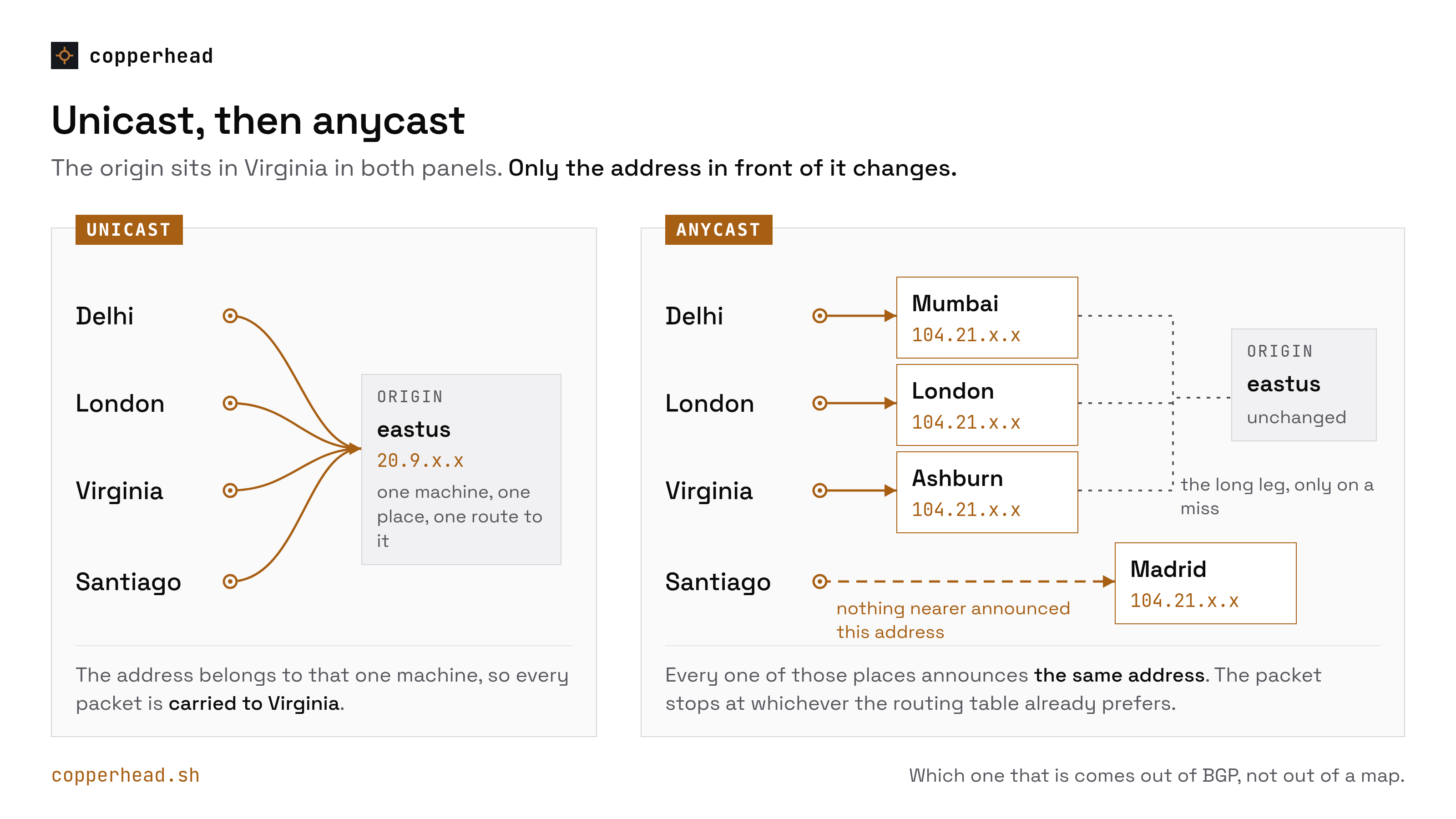
The origin is the same machine in the same region in both panels. What changes is that the address in front of it is answered in more than one place, and that nothing in Santiago gets a say in which place answers it.
Cloudflare’s glossary entry on anycast networks is the short version, and it describes the network we ended up sitting behind. Wikipedia’s article is the one to read for the detail: RFC 1546 in 1993 and the thirteen DNS root server addresses that are each served by clusters of hosts in many places at once. It also carries the old objection to running TCP over anycast at all, that a long lived connection could be re-routed to another instance mid-flight, which measurement has since put below 0.017% of connections.
Two things follow from “whichever one it already prefers”.
The first is what we were after. If the address is answered in Singapore then the three round trips before the first byte are three short ones, and the origin has not moved an inch.
The second is what it cost us. Preferred is not nearest. BGP compares AS path length and then whatever local policy an operator has configured, and that policy answers to what transit and peering cost in a given market. A location with no nearby announcement, or with a cheaper path to a distant one, gets the distant one. Nothing in the protocol has ever looked at a map. That is the shape of the explanation we reach for in South America later, and it is also why we cannot settle it without knowing which point of presence answered.
An edge in front of an unchanged origin
So we put an anycast edge in front of the origin and changed nothing behind it. No
second region, no second cloud, no application code. TLS now terminates at a point of
presence near the visitor, so all three handshake round trips become short ones. The
long leg to eastus runs over a connection the edge already holds open, and requests
the edge can answer by itself never make that leg at all.
Four things the edge is not allowed to get wrong
An edge in front of an application is a cache, a TLS terminator and a place to answer requests early. Each of those is a way to serve the wrong person the wrong bytes. We wrote down four rules before touching anything.
The certificate moves before the record does
Our origin held a cloud-managed certificate, and that kind revalidates by resolving its own hostname. Once the edge answers for that hostname, revalidation can fail. The certificate does not break then. It stops renewing and expires months later, at which point an edge set to verify the origin strictly refuses every request at once. So the origin moved to a long lived certificate from the edge’s own authority, which has no such dependency.
The order matters in the other direction too, since that certificate is trusted by the edge and by nobody else. Bind it while the hostname still resolves to the origin and every visitor gets a certificate error until the record flips. So the rollout uploads in one step, which moves no traffic, then does the bind and the proxy back to back in a second.
The redirect fails closed
Signed out visitors asking for a console page get redirected to the login page, and
that redirect used to cross to eastus, call the auth service and come back to say
“log in”. Moving it to the edge is safe in one direction only. The rule is conditioned
on the absence of a session cookie and on nothing else, because absence proves a
request cannot be authenticated while presence proves very little: the edge verifies
no signatures. A request carrying a cookie goes to the origin untouched, valid or
forged, so the origin stays the only thing that decides anything.
Disable the rule and nothing gets weaker, since signed out visitors still cannot reach a console page: the server side check never moved. We wrote that into the spec so nobody later mistakes a saved round trip for an authorization boundary. Verifying session tokens at the edge would answer more requests locally and move identity out of server code, which is an architectural decision rather than a routing change.
The cache is a list, not a policy
Static assets are cached at the edge for a year. HTML never is. The tempting shape is “cache everything, except the things that must not be cached”. We wrote the inverse: an enumerated list of content hashed, immutable paths, everything else uncached by default. The failure modes decided it. A narrow list missing an entry serves from the origin something that could have come from cache. A broad policy missing an exclusion serves one org’s rendered page to another org’s viewer.
The origin stops answering the public internet
An edge that applies rules to app.copperhead.sh while the origin’s own cloud
hostname keeps answering everyone is advisory at best. Anyone who finds that hostname
bypasses the redirect rules, the cache policy and the content protections in a single
request. So the origin’s ingress is restricted to the edge’s published address ranges,
and that restriction is what collided with everything else.
The lockdown broke our own deploy pipeline
Our production deploys are gated. A new revision is created at zero traffic weight, addressed by its own unique hostname, smoke tested and only then given traffic, so a bad build never serves a user. No edge answers for that candidate hostname. The moment we restricted the origin to edge addresses, our deploy pipeline could no longer reach the thing it was about to ship.
The fix admits the deploy runner for the length of the gate and then takes the allowance away. Three details of it matter more than they look. It has to skip when no restriction exists, because Container Apps ingress fails open on an empty rule list and closed at the first Allow rule: adding one rule to an unrestricted app denies everyone else instantly. It has to write the allow list in a single request, since one range at a time leaves every point of presence whose range has not landed yet denied until the fifteenth call returns, a rolling 403 produced by the command meant to protect the origin. And the removal has to run whether the gate passed or failed. A failed smoke test is precisely the case where a runner’s address would otherwise stay admitted, and cloud runner addresses get recycled to somebody else within minutes.
What broke, and why it took an hour to see
The edge redirect needs to carry the visitor’s original path in a query parameter, so
they land where they were going after signing in. That means percent encoding it. We
wrote url_encode(...), and the rules language has no encoder on any plan. Every
attempt to create the rule returned a 400, so the rule never existed. Nothing looked
broken, because the origin went on serving that redirect as it always had. The console
redirected correctly. It redirected from Virginia.
There is no workaround on our plan: regex_replace would do it and needs a business
tier. Emitting the raw path would have been wrong rather than merely lossy, since an
unencoded & ends the parameter and starts another, so /runs?a=1&b=2 arrives as
next=/runs?a=1 with the rest discarded. The rule now excludes requests carrying a
query string, and those fall through to the origin, which encodes correctly and always
has. A first time visitor arriving at / or /projects is answered at the point of
presence. A parameterised deep link pays the round trip it was already paying.
The hour went to the error message. Our API helper used curl -f, which discards the
response body on a 4xx, so a 400 naming the identifier the vendor could not resolve
reached the operator as “failed at the transport”. Four other checks in the rollout
reported a failed read as a definitive negative: a zone setting it could not read was
reported as not offered, a branch it could not read as a branch missing a step. The
dangerous one failed permissively. With the DNS tool absent, the IPv6 guard passed and
would have locked the origin down having verified nothing.
A fifth appeared on the first real lockdown. The read back asked the cloud API for
length(ipSecurityRestrictions) before its read model had caught up and got null,
which is a type error rather than an empty list, so the script printed this:
edge lockdown failed; origin ingress not changedThe rules were in place, the origin was refusing everyone but the edge and the site was serving normally. If you build operator tooling, give “I could not check” its own branch and its own message.
What it measured
Same probe set and same target, seven days after the baseline.
| Region | 16 August | 23 August | |
|---|---|---|---|
| Asia Pacific | 627 ms | 138 ms | 4.5x |
| Europe | 293 ms | 58 ms | 5.1x |
| America | 172 ms | 221 ms | 0.78x, worse |
The average across all locations went from 373 ms to 139, and the report’s own grade from C to A.
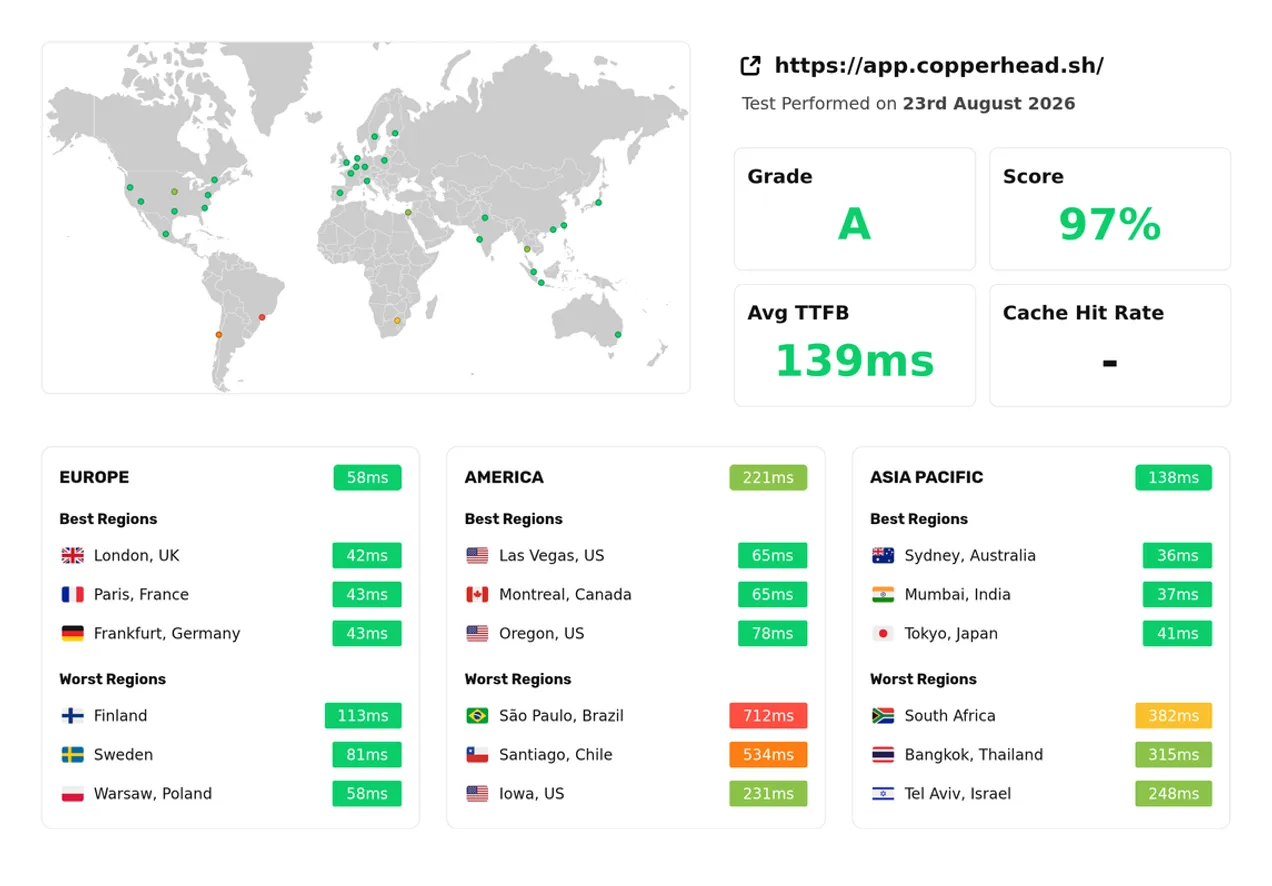
The same report a week later. The map that was red across Asia is green, and the two coloured dots in South America are the probes that went backwards.
By location, from that run:
| Location | 16 August | 23 August | |
|---|---|---|---|
| Mumbai | 707 ms | 37 ms | 19.1x |
| Sydney | 609 ms | 36 ms | 16.9x |
| Delhi | 775 ms | 89 ms | 8.7x |
| London | 253 ms | 42 ms | 6.0x |
| Northern Virginia | 35 ms | 93 ms | 0.4x |
| Iowa | 107 ms | 231 ms | 0.5x |
| Santiago | 363 ms | 534 ms | 0.7x |
| Sao Paulo | 373 ms | 712 ms | 0.5x |
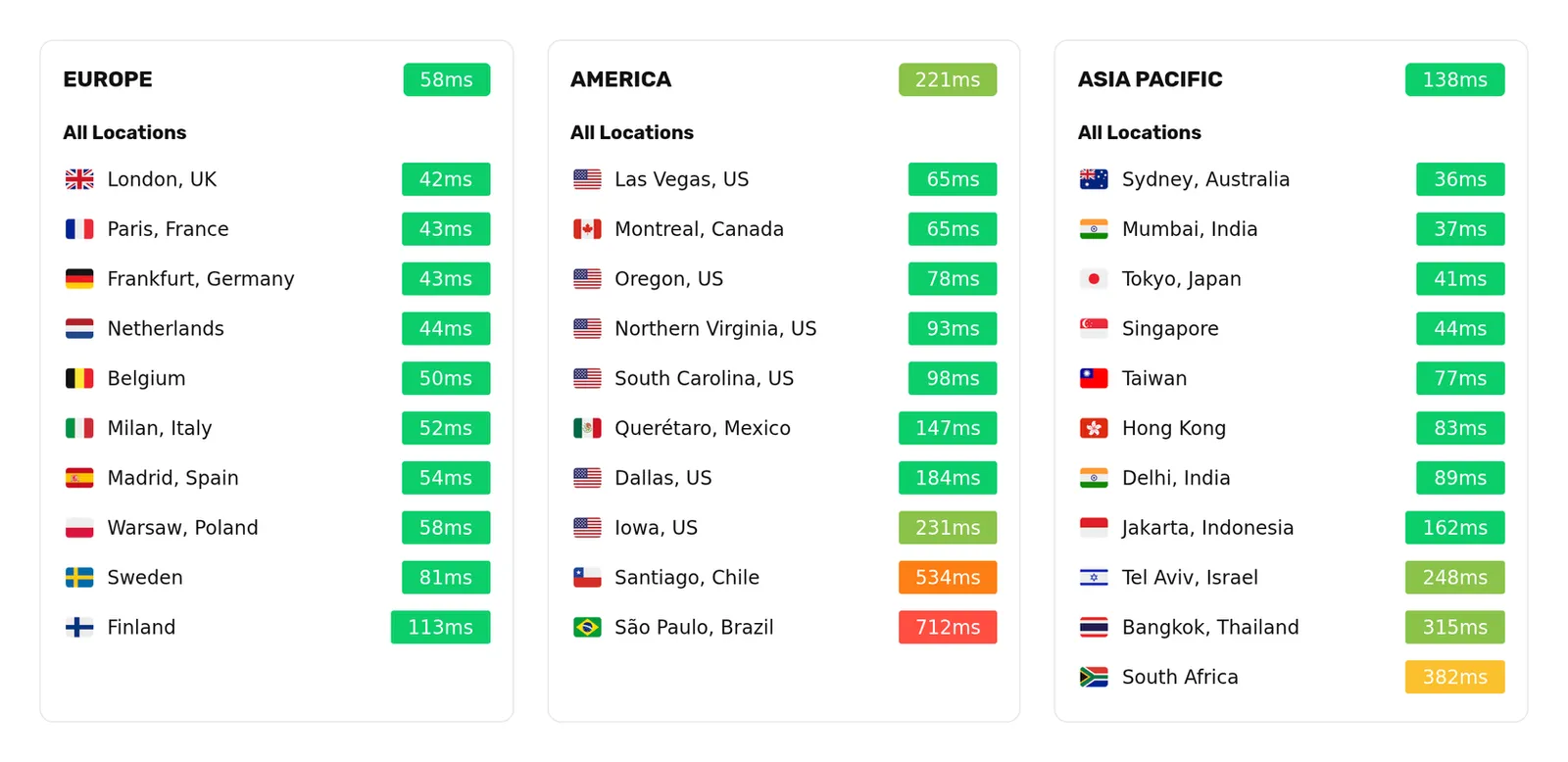
All thirty one locations in that run. The badges that are not green are Santiago, Sao Paulo and South Africa.
Asia Pacific and Europe beat our own projection of roughly 2.5x. The probes closest to the origin went the other way, which we expected in direction: next door to Virginia the edge is one more hop rather than one fewer. We did not expect Northern Virginia to lose 58 ms or Iowa to lose 124.
Static assets serve warm from cache without touching the origin.
cf-cache-status: HIT
age: 18211
cache-control: public, max-age=31536000, immutable
The report cannot show that, which is why its cache hit rate reads as a dash on both
screenshots. It requests app.copperhead.sh, which now answers a 302 at the edge. A
302 carries no cache status, so reading the hit rate needs a separate run against a
cacheable URL. The edge tier itself runs on a free plan.
The second run disagreed
We ran the same probe set again on 24 August, against an unchanged system.
| Region | 23 August | 24 August |
|---|---|---|
| Asia Pacific | 138 ms | 160 ms |
| Europe | 58 ms | 90 ms |
| America | 221 ms | 197 ms |
Per location the spread is wider than those averages suggest. Delhi came back in 89 ms and then 219. Finland 113 and then 316. Santiago 534 and then 756. Sao Paulo went the other way, 712 and then 451. London barely moved, 42 and then 32.
The two runs agree on direction: a large win across Asia Pacific and Europe, a loss in South America, a smaller loss near the origin. Neither pins down the size of any of it. What moves between them is which point of presence answers a given probe. The 24 August run recorded Belgium as answered from Paris at 168 ms while Paris itself came back in 44, and Finland from Stockholm at 316 while Sweden came back in 71. Where the nearest point of presence is not the one used, the edge adds a leg instead of removing one.
The part that got worse
Santiago and Sao Paulo were slower after the change in both runs, and they pull the America average below its own baseline. Our proposal did not predict that. It called the change “neutral near the origin” and did not consider any location getting materially worse.
The explanation we have is a hypothesis. If the edge answers those probes without fetching the origin, the model above puts Santiago’s 534 ms at around 170 ms of round trip and Sao Paulo’s 712 at around 230. Santiago to Miami is roughly 120 ms, to Los Angeles roughly 160, to Madrid roughly 230. Both cities have a point of presence of their own, so implied round trips in that range are consistent with the probe being answered a long way off, plausibly from North America or Europe. Consistent is as far as we can take it: we captured no responding colo and ran no traceroute from either city, and either would settle it.
Free plan anycast does not guarantee the nearest point of presence, and Latin America is often named as a case where it does not, since transit and peering there cost more than in Europe. That is a guess at the cause rather than a finding. Until the colo is captured we cannot say whether this is the plan we are on or something we configured.
What this does not fix
The summary is a large win across Asia Pacific and Europe, a real loss in South America and a smaller one beside the origin. We are recording it that way rather than folding it into a regional average, because an average that hides a doubled latency is not a result. That loss is cheap to accept while almost nobody there uses the product, and it stops being cheap the moment that changes. Smart routing is the lever, deferred on the grounds that it should follow a measurement. This is that measurement.
Nothing here made the application faster, either. The origin still contributes its 20
milliseconds and still resolves identity in eastus, so an authenticated page pays
for that single region on every request the edge cannot answer alone. The three round
trips are shorter now. There are still three of them.
Both open questions need a measurement rather than a decision: one probe run against a cacheable URL, and one from Santiago that records which colo answered.
copperhead is a hosted platform for hardware design agents. The edge tier described
here is deployed on app.copperhead.sh.